

The driver shortage is now a service shortage — and the depot is where you win capacity back Across...
A safety driver removes the main benefit of an autonomous bus: driver time returned to line service. On public roads, the safety driver is on board for every hour the bus runs, and the operator pays for the autonomous system as well. Payback starts when the bus moves with nobody on board. The depot is the first place where a city bus can work without a safety driver.

The safety-driver trap
Autonomous buses have been "almost ready" for more than ten years. Demonstrations with safety drivers began around 2015, and in most projects we see today, a person still sits in the driver's seat.
In Bad Birnbach, Germany's first automated bus on a public road carried an attendant from its first day. Under EU rules, the attendant was still on board when the service ended in 2024. In 2026, Munich's MINGA pilot on a full-size bus starts with a safety driver on board, as public-road engineering requires.
The reason is physics. A city bus carries dozens of passengers, many of them standing, at speeds of up to 50 km/h. When something goes wrong, the system must bring the bus into a safe state. A hard stop can injure standing passengers, so the right reaction depends on the situation. Until a system proves that it can handle every such situation alone, the responsibility stays with a human on board.
That keeps passengers safe. It also removes the business case: the operator replaces a driver with a safety driver and pays for the technology as well. A bus with a safety driver is not autonomous — it is simply a more expensive bus. We call this the safety-driver trap.
What the numbers show
The business case for bus autonomy rests mainly on one benefit: driver time returned to line service.
On a public road, a safety driver sets the main benefit to zero. The person on board is on duty for every hour the bus runs, so no driver time returns to service. The cost of the system stays.
A second cost is harder to see in a spreadsheet. A safety driver must be able to drive the bus, so the seat needs a person with a bus licence, and that is the person Europe is short of. The IRU counted around 105,000 unfilled bus and coach driver positions in Europe in 2023, about 10% of all positions. It warned that the gap could exceed 275,000 by 2028 without action, and reported that more than 40% of drivers are over 55. Each safety driver is a qualified driver missing from the timetable.
Inside the depot, a bus can move with nobody on board. There, driver time returns to line service. Across assessed depots, manual depot movement takes 10 to over 35 minutes per vehicle per day, depending on depot layout, fleet size and shift organisation. At MZA Warsaw, the measured figure is about 35 minutes a day for each bus. In MZA's assessment, the recovered driver time alone was valued at over €88,000 per vehicle over a 12-year lifecycle.
For a depot with 100 buses, The State of Smart Depots 2026 models 25 minutes per bus per day. That is about 42 driver-hours every day. At an indicative European cost of €35–45 per fully loaded driver-hour, this time is worth €500,000–700,000 per year. An operator can run the same estimate with its own numbers in Depot Minutes, a free online tool for depot time estimates.
| Setting | Who is on board | Driver time returned to line service | Value of that time per year |
|---|---|---|---|
| Public road, full-size pilot | A safety driver, for every hour the bus runs | 0 hours | €0 |
| Depot, manual operation | A driver, for every manoeuvre | 0 hours | €0 |
| Depot, smartbuses with 🚫 NO safety driver | Nobody; the Smartbus Coordinator supervises | about 42 driver-hours per day, for 100 buses | €500,000–700,000 |
Indicative model values: 100 buses, 25 minutes per bus per day, €35–45 per fully loaded driver-hour. The figures value driver time alone. They exclude the cost of the system and the price premium for a drive-by-wire bus. Results depend on the site.
An autonomous bus becomes real when the safety driver leaves
The depot changes the physics. A smartbus moves inside the depot at low speed, with no passengers, on a known layout. When the system detects something unexpected, it slows down or stops. At that speed and with an empty bus, stopping is the safe reaction, and it puts no passenger at risk.
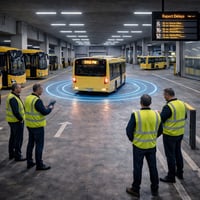
This is why a smartbus can operate with 🚫 NO safety driver. A smartbus is an ordinary city bus with SmartDEPOT™ by Autonomous Systems. It is designed to move around the depot with nobody in the vehicle. The Smartbus Coordinator, a new role in the operator's organisation, supervises the smartbuses through SmartDEPOT™ Mission Control. Today the closest roles are the managers of shunting drivers and the garage managers. The driver hands the bus over at the depot entrance. The bus then parks, charges and moves between depot areas, and waits at the exit for its next driver.
Supervision is still a human job. When a bus stops, it informs the Coordinator. Depot staff handle exceptions on site.
A depot is a private site with controlled access, which makes the approval path shorter than on public roads. The duty to prove safety stays the same: a documented safety assessment, validated performance and a clearly defined operating domain.
Where autonomy pays first
Autonomy creates value in public transport when driver time goes back to passenger service. The depot is where that happens first: low speed, no passengers, a known site, 🚫 NO safety driver. Every autonomous depot movement also builds the operating record that autonomy on public roads will need later.
Our BB-1 minibus runs its development tests with no safety driver on board at our technology park in Gliwice, supervised from SmartDEPOT™ Mission Control on site. Autonomous Systems has carried out depot assessments with operators in Belgium, Spain, the Netherlands, Norway, Poland and Switzerland. MZA Warsaw is designing its new Redutowa depot for smartbus operations.
Start with the numbers. The 100-bus model, its assumptions and the MZA Warsaw assessment are in our free report, The State of Smart Depots 2026. It is available in English, Polish, German, French and Spanish.

If you are planning a new depot or a fleet renewal, the Smartbus Onboard Program assesses feasibility, safety and ROI for your site.
Smartbuses in every depot.
Frequently asked questions
Do autonomous buses still need a safety driver?
On public roads in Europe, a safety driver or attendant is still on board in most projects. In Bad Birnbach, Germany's first automated bus on a public road carried an attendant until the service ended in 2024, under EU rules. Munich's MINGA pilot on a full-size bus starts in 2026 with a safety driver on board. Inside the depot, a smartbus is designed to move with nobody on board, under remote supervision.
Why does a safety driver cancel the ROI of an autonomous bus?
The main benefit of an autonomous bus is driver time returned to line service. On public roads, a safety driver is on board for every hour the bus runs, so no driver time returns, and the cost of the system stays. Inside the depot, a smartbus is designed to move with nobody on board. That is where the time returns first.
What do you call a city bus that drives itself inside the depot?
A smartbus. A smartbus is an ordinary city bus with SmartDEPOT™. It is designed to park, drive to its charger and move between depot areas with nobody on board. Starting bus automation inside the depot is called depot-first autonomy: driver time returns to line service without waiting for public-road approval.
How many driver minutes a day does a city bus spend inside the depot?
Across assessed depots, manual depot movement takes 10 to over 35 minutes per vehicle per day, depending on depot layout, fleet size and shift organisation. At MZA Warsaw, the measured figure is about 35 minutes a day for each bus: parking, charging approach, washing and repositioning. That is roughly the equivalent of one extra month of driving time per driver each year, and it returns to line service when the bus moves with nobody on board.
What should a public transport operator look for in a partner for autonomous depot operations?
Clear answers to four questions: Who is accountable when the vehicle does something unexpected? Where does the operating data live, and who can reach it? Who can stop the vehicle, from where, and how fast? Can all of that be shown to an auditor? Then a measured baseline from an assessment of the operator's own depot.
Read next: Where does depot autonomy for city buses stand in 2026?
Sources: Autonomous Systems, The State of Smart Depots 2026 (indicative values, including the MZA Warsaw assessment) · IRU, Europe's bus and coach driver shortage widens 54%, 9 October 2023 · ZfK, Autonome E-Busse in Bad Birnbach fahren nicht mehr, 6 January 2025 · Deutsche Bahn, First autonomous vehicle on public roads · Sustainable Bus, The bus industry's smartphone moment, 1 October 2026
Jan Gramatyka is Co-CEO of Autonomous Systems, a European technology company based in Gliwice, Poland, that develops SmartDEPOT™, an autonomous driving system for city buses in depots.