

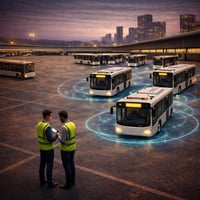
While fully autonomous city buses capture headlines, the real transformation in public transport is...
It's 23:17. The last bus rolls through the gate.
The driver runs the end-of-day routine: park, plug in the charger, fill in the defect report on the tablet. A scratch on the left rear panel from a tight turn at the terminal — noted. An intermittent wiper — flagged for the morning. Charging indicator green. Done.
Except it isn't done.
The depot manager calls over. That bus is blocking the wash lane — it has to move before the cleaning crew can reach the vehicles behind it. The bus at bay 14, the one with the wiper fault, needs to be at the workshop entrance before the technicians arrive at 06:00, so someone has to reposition it tonight. And while that's happening, the charging rotation has to run: three buses on the slow chargers need to swap onto the fast units to be ready for the early departures.
By the time the driver actually walks out, it's nearly midnight. The shift started at 11:00 that morning.
This is the part of public transport nobody photographs. It has a name — shunting — and it's the continuous stream of non-revenue movements that happens after the driver returns and before the next shift begins: repositioning, maintenance staging, charging approach, dispatch sequencing. None of it carries a passenger. All of it consumes the scarcest resource you have.
By 04:30, every charged and checked bus has to be staged in departure order, ready for the drivers arriving at 05:00 who expect their vehicle exactly where it should be. Then the cycle starts again.
Here's what surprises operators when they measure it. Depending on layout, fleet size and shift organisation, manual depot movements consume somewhere between 10 and over 35 minutes per vehicle, per day. At a depot running 100 buses, even 25 minutes per bus adds up to roughly 42 driver-hours lost every single day — to parking, charging approach, repositioning and staging. Inside the fence. Off the clock that matters.
And it isn't only time. Depots are among the most hazardous environments in public transport: big vehicles, tight spaces, mixed foot and vehicle traffic, variable light, and staff who are most fatigued exactly when the yard is most congested. Large manually operated depots see three to four minor collisions a week — mirror strikes, shallow body scrapes, charging-cable contacts — clustered in those late-evening hours. Each one is a repair bill, downtime and paperwork. Most of them happen during reversing manoeuvres.
We manage the operational heart of every transport network — the depot — roughly the way we did a generation ago. We've electrified the fleet, digitised the timetable, modernised almost everything the passenger sees. The yard behind the fence is the part the modernisation skipped.
It's 23:17. The question worth asking isn't whether your drivers can do this work. They can, and they do, every night. The question is whether driving a bus at 15 km/h across an empty yard is the best use of the most expensive and most scarce hour in your operation.
We measured this bottleneck across multiple European depots and put the numbers — time lost, collisions, the cost of both — into The State of Smart Depots 2026.

See what 23:17 is actually costing you.