

I've spent this series making the case. Let me end it with facts, because the strongest case for...
More than a vehicle
A bus that drives itself is only useful if it knows where to go, when to charge, and how to fit into a depot that was not designed around it. Autonomous movement is the visible part. The ecosystem that makes it operational is not.
But the vehicle is only one part of what makes depot autonomy work. A smartbus operating in isolation — without integration into the depot's charging infrastructure, management systems, and operational procedures — delivers a fraction of its potential value. The real capability emerges when the vehicle, the infrastructure, and the systems around it are designed to work together.
That combination is the Smart Depot ecosystem. This article explains what it consists of, how the layers interact, and why the ecosystem approach is itself a key advantage over attempts to deploy autonomous buses on public roads.
Two ecosystems: controlled vs. uncontrolled
To understand why depot autonomy works, it helps to contrast it with the ecosystem that public road autonomy requires.
An autonomous bus operating on city streets depends on an ecosystem it does not control. Traffic signals managed by the municipality. Road markings maintained by someone else. Other road users behaving unpredictably. V2X communication infrastructure that does not yet exist at scale. Maps of the entire city that must be continuously updated. Regulatory frameworks that differ across cities and countries.
The vehicle must navigate all of this without owning any of it. Every element of the external ecosystem introduces uncertainty that the system must handle — and the system has no ability to change or simplify any of it.
A bus depot is the opposite. The operator owns the space. The operator controls who enters and when. The infrastructure — chargers, wash bay, parking lanes — can be designed or adapted with autonomy in mind. The management systems can be integrated directly. Every layer of the ecosystem is within the operator's control.
This is not a subtle difference. It is the difference between designing a system for a known, bounded environment and designing one for an open world. The table below captures the contrast:
|
Public road ecosystem |
Depot ecosystem |
|
Infrastructure owned by third parties |
Infrastructure owned by the operator |
|
Maps cover entire city — continuous updates required |
Map covers one depot — updated on change |
|
V2X requires external rollout |
Internal communication — closed network |
|
Unknown participants — public |
Known, trained personnel |
|
Regulation varies by city and country |
Private land — unified approval scope |
|
Ecosystem cannot be adapted to the vehicle |
Ecosystem designed around the vehicle |
Three layers of the Smart Depot ecosystem
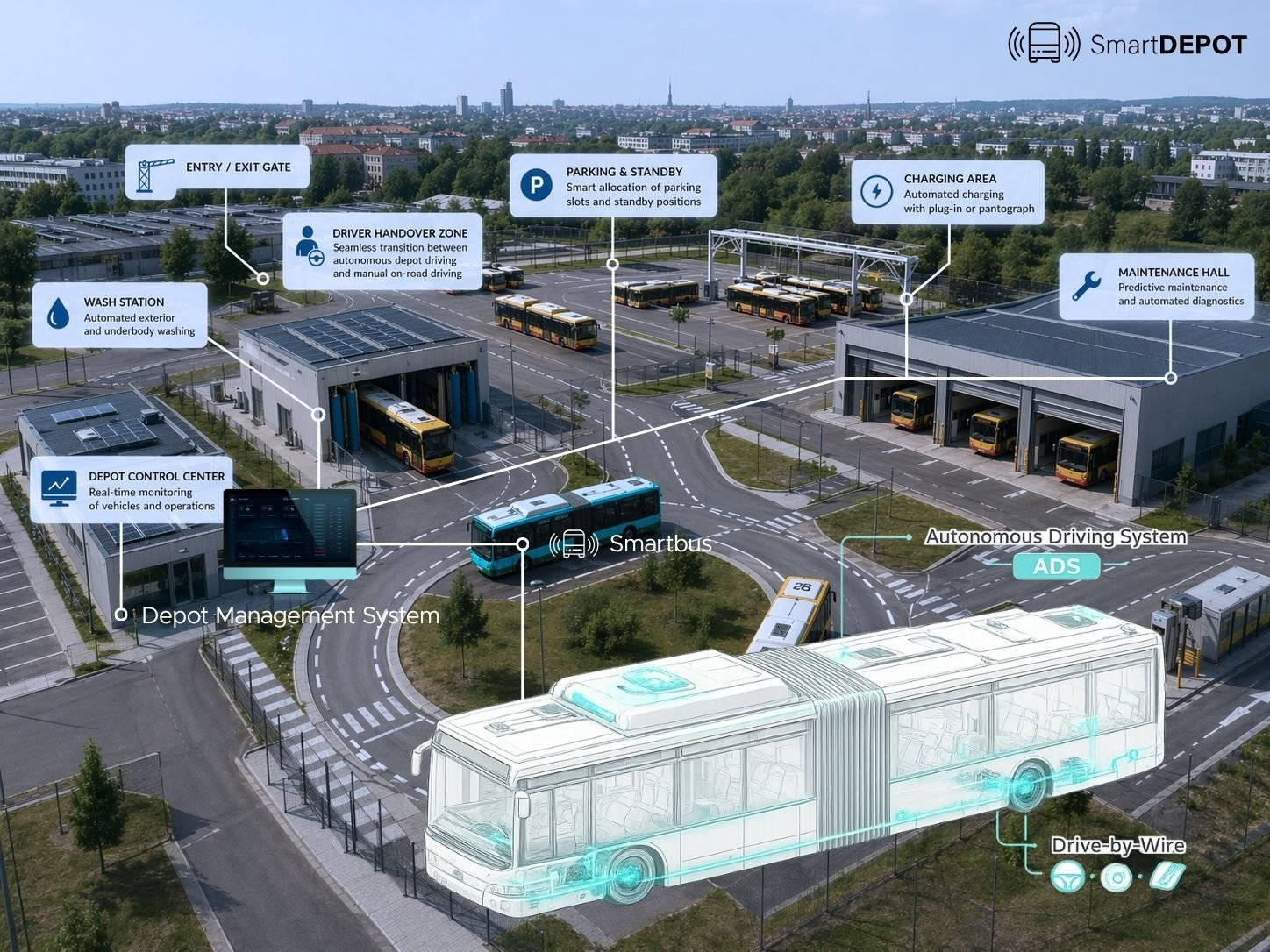
The Smart Depot ecosystem consists of three layers that must work in concert: the vehicle itself, the physical depot infrastructure, and the management and control systems that coordinate everything. Each layer has its own role, and the value of autonomy scales with how well they are integrated.
Layer 1: The vehicle — smartbus
The smartbus is an ordinary full-size bus — typically a standard 12-metre vehicle — equipped with the SmartDEPOT™ system. It does not require a new vehicle platform or a custom chassis. The system is installed on production buses, which means operators can work with their existing fleet relationships and procurement processes.
The core of the onboard system is perception and localisation. SmartDEPOT™ uses LiDAR sensors mounted on the vehicle to build a real-time picture of its immediate environment. Unlike camera-based systems, LiDAR operates independently of lighting conditions — it functions the same way at 3 AM in a dark depot as it does at midday. The system detects obstacles, people, and other vehicles within its operational range and responds accordingly.
Localisation is based on HD Maps rather than real-time SLAM (Simultaneous Localisation and Mapping). The depot is mapped in advance with high precision. During operation, the vehicle continuously matches its LiDAR readings against the stored map to determine its exact position. This approach is well-suited to a depot environment: the space is stable, changes are infrequent, and when they do occur — a new charging bay, a relocated piece of equipment — the map is updated deliberately rather than discovered on the fly.
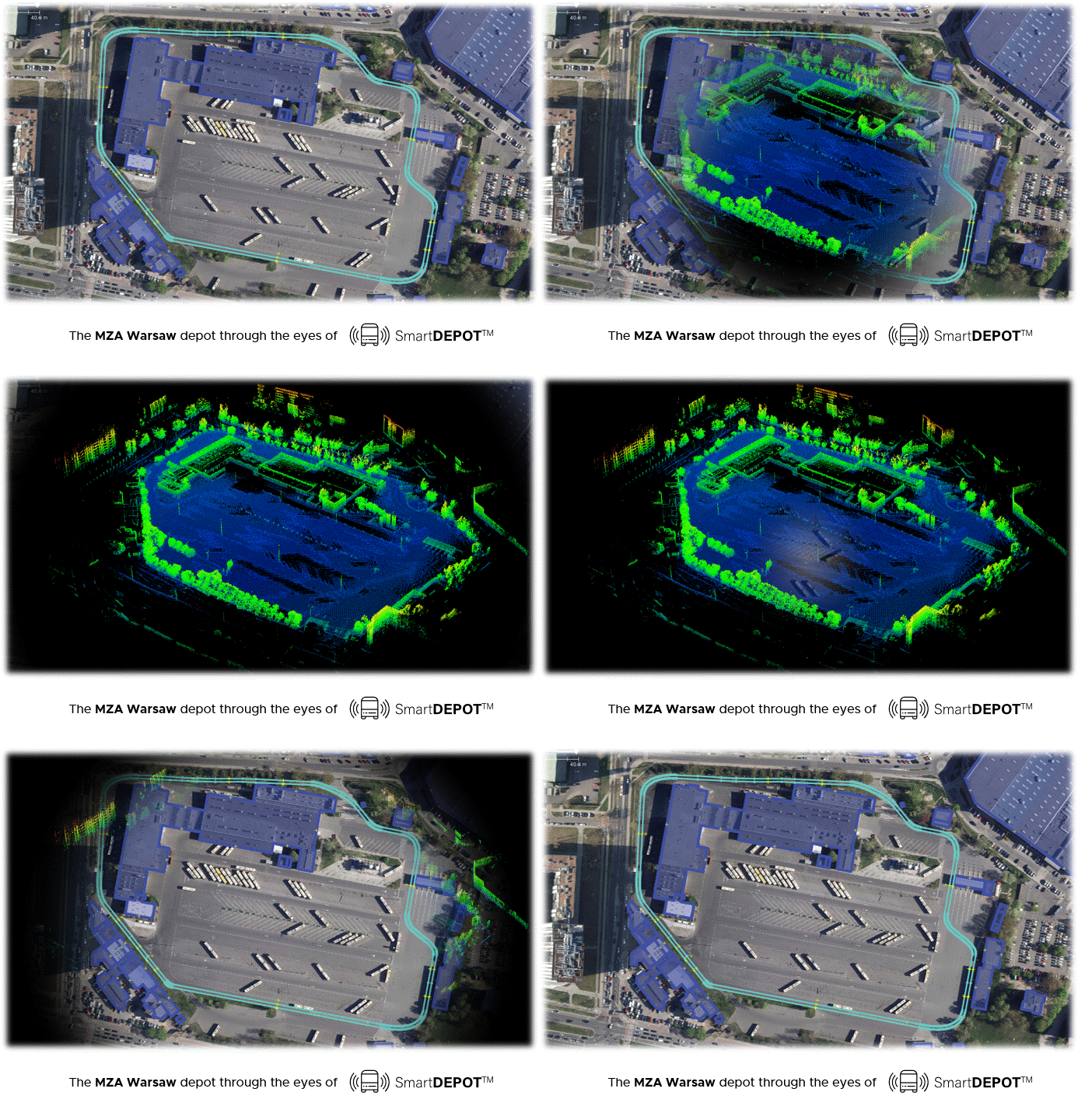
The onboard system handles path execution, obstacle avoidance, and low-level vehicle control. It also communicates continuously with Mission Control — the fleet-level management layer — receiving assignments and reporting status. The vehicle does not make fleet-level decisions independently; it executes what Mission Control instructs, within the safety boundaries it enforces itself.
Fail-safe behaviour is straightforward: in any situation the system cannot confidently resolve, the vehicle stops. At the operating speeds of a depot — a maximum of 10 km/h — stopping distance is approximately 1.3 metres. An immediate stop is both safe and sufficient. This simplicity is a deliberate design choice, and it is only possible because of the controlled environment.
Layer 2: Depot infrastructure
The physical infrastructure of the depot is the environment the vehicle operates within. For a smartbus, that infrastructure is not just a backdrop — it is an active part of the system.
Charging
Electric fleet management is one of the most operationally complex challenges facing depot operators today. Each bus has a charging window defined by its next departure time. The depot has a finite number of charging points. Grid capacity limits how many vehicles can charge simultaneously. Managing all of this manually — or through a disconnected system — creates bottlenecks and suboptimal charge states.
In a Smart Depot, charging is integrated with autonomous movement. Mission Control knows the departure schedule, the current state of charge of each vehicle, and the availability of charging infrastructure. It dispatches buses to charging points autonomously, sequences arrivals to avoid congestion, and adjusts plans dynamically as the schedule changes. The result is a depot that manages its energy consumption as an active system rather than as a sequence of manual decisions.
This integration requires the charging infrastructure to communicate with Mission Control — reporting availability, current draw, and faults. The specific charging hardware is operator-selected; the Smart Depot system integrates at the data level, working with the management interfaces that charging providers expose.
Wash bay and service points
The same logic applies to the wash bay and any other fixed service points in the depot. A smartbus can be dispatched to the wash bay autonomously, queue without a driver, and proceed to its next assignment — parking or charging — after washing is complete. The vehicle does not need a driver to move between service stations during off-service hours.
This is where depot autonomy generates some of its most direct operational value. The tasks that currently require a driver — moving a bus from charger to wash bay at 2 AM — are exactly the tasks that drivers find least rewarding and that operators find hardest to staff. Automation of these movements is immediately useful, independent of any longer-term ambitions.
Physical layout
Depot layout does not need to be redesigned for Smart Depot deployment, but it does need to be mapped and understood. Narrow lanes, low-clearance structures, and ambiguous routing points are handled through the HD Map and the path planner. In some cases, operators choose to make minor physical changes — clearer lane markings, improved lighting in sensor coverage zones — but significant infrastructure investment is not a prerequisite.
What the layout does need to support is predictable access patterns. A depot where vehicles can enter and exit charging zones in a defined sequence is easier to manage autonomously than one with ad-hoc movement patterns. Part of the deployment process involves understanding the depot's physical constraints and reflecting them accurately in the HD Map and Mission Control's routing logic.
Layer 3: Management and control systems
Mission Control
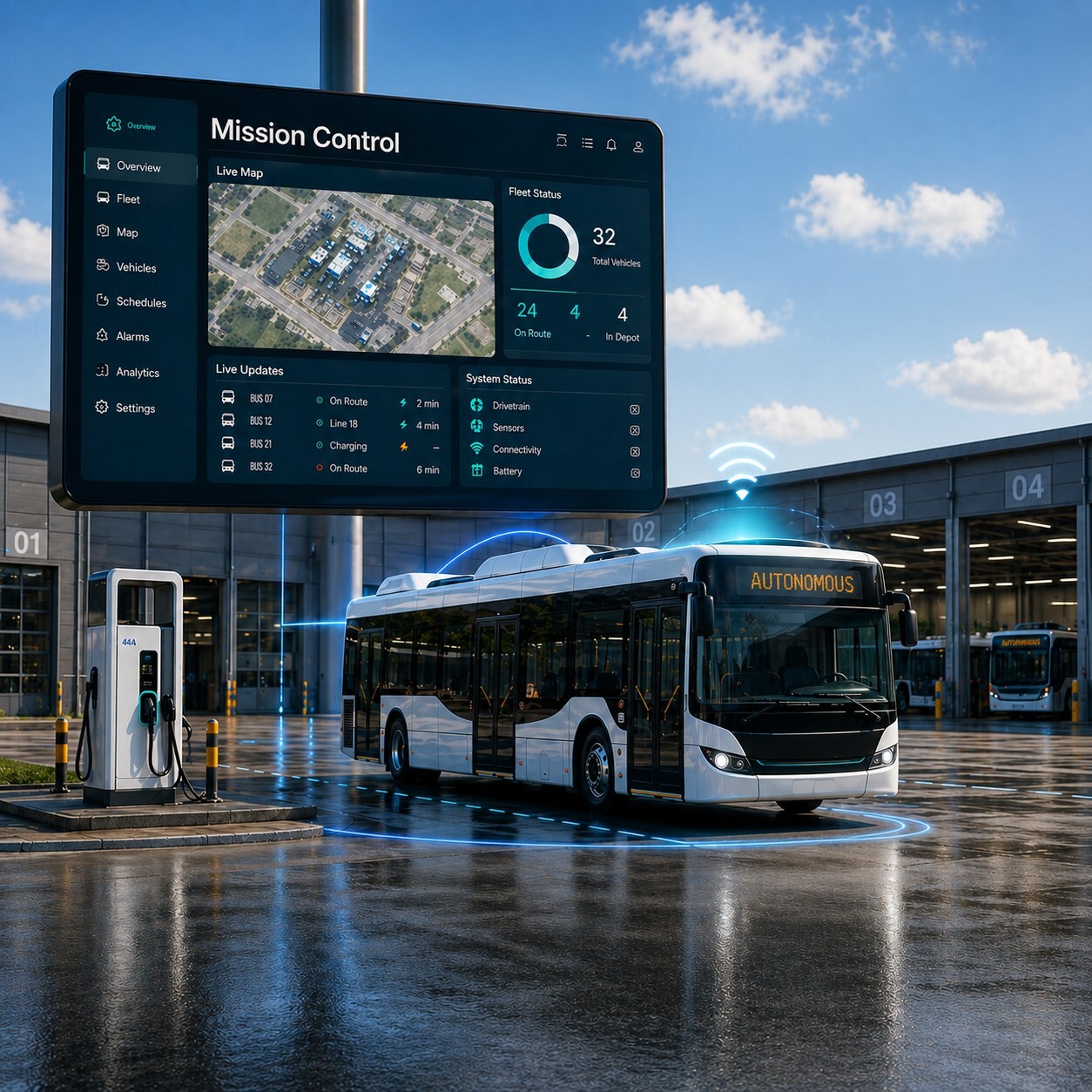
Mission Control is the coordination layer of the Smart Depot ecosystem. It holds the fleet-level view: which vehicles are where, what their charge state is, what the departure schedule requires, and what tasks need to be executed in what order.
Mission Control makes the sequencing decisions that would otherwise require a depot coordinator: which bus goes to which charger, in what order buses enter the wash bay, how the parking layout is optimised for the next morning's departures. These decisions are made continuously, not as a one-time plan, and they adapt as conditions change — a delayed bus, a charging point fault, a schedule revision.
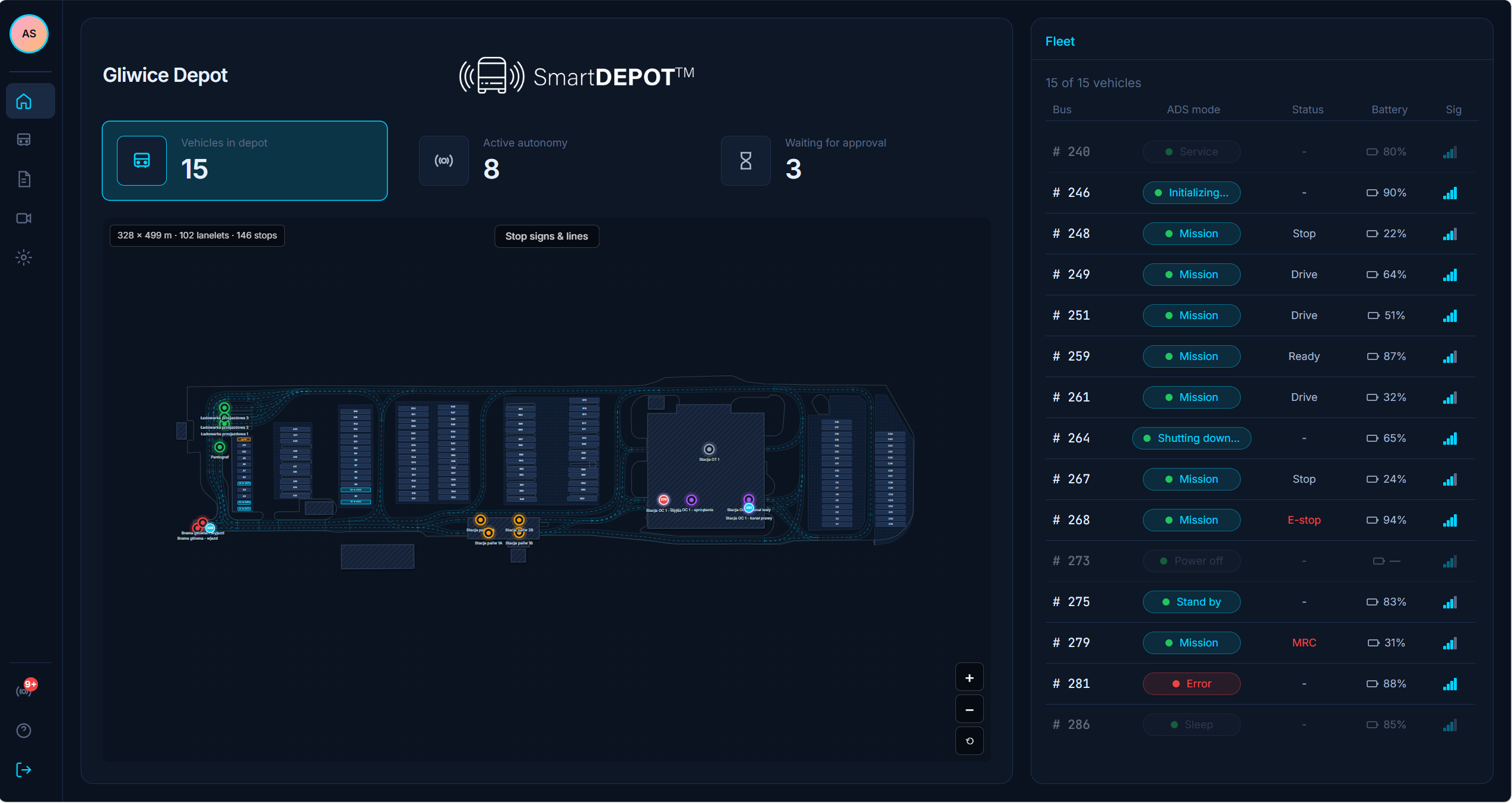
The boundary between what Mission Control decides autonomously and what it escalates to a human operator is explicit and configurable. Routine movements — parking, charging, wash cycles — are handled without human input. Situations outside the expected operating envelope — an obstacle the system cannot resolve, an infrastructure fault, an unexpected vehicle state — are flagged to the operator for intervention. The operator sees a clear status view and acts on exceptions rather than managing every movement.
Integration with depot management systems
Most operators already run a depot management system (DMS) or dispatch system that handles scheduling, driver assignment, and fleet status. Smart Depot does not replace these systems — it integrates with them.
The integration point is the schedule and fleet status data that the existing DMS holds. Mission Control reads departure times and vehicle assignments from the DMS and uses that information to plan autonomous movements. Status updates — vehicle location, charge state, readiness — are written back to the DMS so that the operator's existing tools remain the single source of truth for fleet state.
The integration approach is pragmatic: operators have invested in their existing systems, and replacing them is not a condition for deploying Smart Depot. The goal is to make the autonomous layer a natural extension of what already exists, not a parallel system that requires separate management.
Operating a mixed depot: smartbuses and conventional buses together
Most operators will not replace their entire fleet with smartbuses overnight. The practical reality of depot autonomy is a mixed environment: some vehicles equipped with SmartDEPOT™, others operating conventionally, all sharing the same physical space.
This is not a temporary compromise to be resolved later — it is the expected operating model for the foreseeable future. Smart Depot is designed to work in this context.
In a mixed depot, Mission Control manages the smartbuses within the space that conventional operations leave available. Zones where conventional vehicles and drivers are active are treated as dynamic constraints. Smartbuses yield to conventional traffic, wait at conflict points, and take alternative routes when their primary path is occupied. The system does not require dedicated zones or physical separation — it manages coexistence through awareness and priority rules.
For the operator, this means Smart Depot can be introduced incrementally. A single smartbus operating in an otherwise conventional depot delivers value on its own movements. As more vehicles are equipped, Mission Control's coordination becomes more powerful — optimising across a larger fleet, reducing more manual movements, generating more data on depot operations. The ecosystem scales with the deployment.
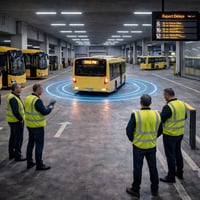
Human workers in a mixed depot require training and clear procedures. Workers need to understand how smartbuses behave — that they will stop when a person is in their path, that they follow defined routes, that they signal their intentions through predictable movement patterns. This is not complex training, but it is necessary. A smartbus in a depot where workers are unaware of its presence and behaviour is an incomplete deployment.
The ecosystem is the product
The value proposition of Smart Depot is not a vehicle — it is an integrated system that makes a bus depot operate more efficiently, more safely, and with less manual labour.
That system only works when all three layers are present and connected: a vehicle that perceives and moves autonomously, infrastructure that communicates its state, and management systems that coordinate the whole. Each layer is necessary. None is sufficient alone.
This is also why the depot-first approach is not simply about technical tractability. It is about ecosystem control. In a depot, the operator can design, own, and manage all three layers. On a public road, the operator controls one. That difference determines what is deployable today — and what is not.