


Whenever I make the case for starting in the depot, someone asks whether it means giving up on the...
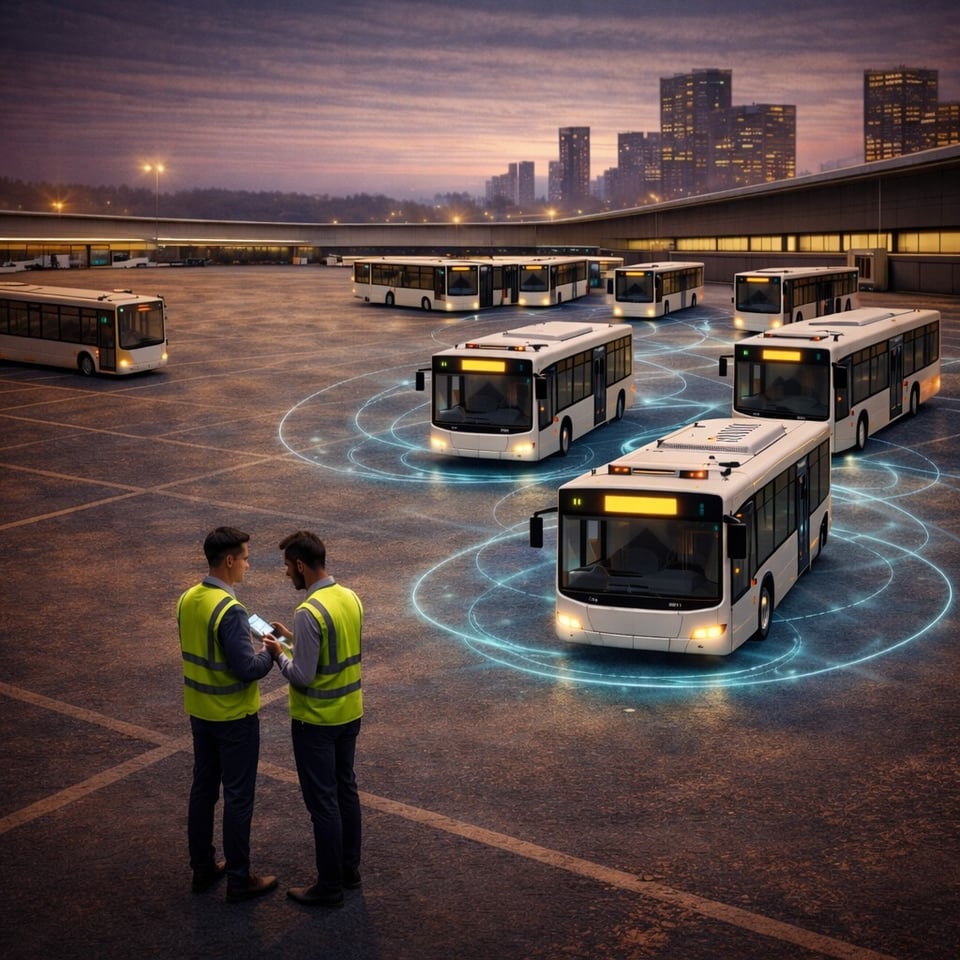
While fully autonomous city buses capture headlines, the real transformation in public transport is happening where nobody's watching — inside the depot, where smartbuses are already delivering measurable ROI today.
The Autonomous Bus Promise: Why City-Wide Dreams Keep Getting Delayed
For years, the vision of autonomous buses has dominated industry headlines and captured public imagination. The promise was clear: driverless vehicles navigating busy city streets, revolutionizing urban mobility, and solving the driver shortage crisis. Billions have been invested in pilots and trials across major cities worldwide, yet large-scale deployment remains frustratingly out of reach.
The reality is far more complex than the vision suggested. Road pilots face a perfect storm of challenges: regulatory frameworks that struggle to keep pace with technology, astronomical costs that don't translate to operational value, and technical hurdles that multiply in unpredictable urban environments. Cities and operators cannot afford to spend millions on pilots that deliver impressive headlines but fail to scale into real, revenue-generating service.
The fundamental problem isn't the technology itself—it's where we've been trying to deploy it first. Public roads present the most complex operational environment imaginable: unpredictable traffic, pedestrians, cyclists, weather conditions, and edge cases that occur daily. Starting with the hardest challenge means progress is measured in years, not months. Meanwhile, operators face immediate pressures—driver shortages, electrification demands, and operational inefficiencies—that need solutions today, not tomorrow.
Where Autonomous Technology Actually Works Today: The Depot Advantage
Every bus begins and ends its journey in the depot. It's here that the industry's most pressing operational challenges converge—and it's here that autonomous technology can deliver immediate, measurable value. Depots are more than parking areas; they are the operational backbone of public transport, where efficiency gains compound across entire fleets.
The depot environment offers distinct advantages for autonomous deployment. It's a controlled, private space with predictable traffic patterns, lower speeds, and known infrastructure. There are no pedestrians crossing unexpectedly, no complex traffic signals, and no regulatory gray zones. This controlled environment allows autonomous systems to operate reliably from day one, focusing on solving real operational problems rather than navigating regulatory uncertainty.
Consider the operational reality: every driver assigned to low-speed maneuvers inside the depot—parking, repositioning for charging, moving vehicles to the wash bay or workshop—is one less driver available for passenger service. In an industry facing critical driver shortages, this represents a massive inefficiency. Tight schedules, fleet electrification, and growing demand make efficient depot management harder every year, while safety risks from low-speed collisions and complex maneuvers add cost and strain to daily operations.
Depot-first autonomy addresses these challenges directly. By enabling buses to park, charge, and move automatically within the depot, smart depot systems free up human drivers to focus on what matters most: serving passengers. They increase safety by removing the burden of repetitive low-speed maneuvers in tight spaces with limited visibility. And they unlock immediate ROI—minutes saved in the depot multiply across an entire fleet, every single day.
Real Operators, Real Results: How SmartDEPOT™ Delivers Immediate Value
SmartDEPOT™ is the heart of every smartbus, turning ordinary buses into autonomous vehicles within the depot environment. This isn't a concept or a future promise—it's a proven solution working in real depots, with real fleets, under real operational constraints. SmartDEPOT™ enables buses to move autonomously around the depot without a driver, delivering immediate operational value where it matters most.
The system addresses the full spectrum of depot challenges. Driver time lost to non-driving work is recovered—every repositioning, parking move, or transfer that previously required a driver now happens autonomously, freeing up real minutes that can be reinvested directly into revenue service. Inefficient depot operations and bottlenecks are eliminated through SmartDEPOT™ Mission Control, which orchestrates charging, washing, inspections, and workshop transfers so every task happens exactly when it should, minimizing downtime and keeping operations flowing smoothly.
Space utilization—a critical constraint in urban depots—is dramatically improved. SmartDEPOT™ optimizes space usage by enabling precise parking, even bumper-to-bumper, and automatically re-parking vehicles when needed to unblock departures. Capacity is maximized without expanding infrastructure or relocating facilities. Safety improves significantly through 360° laser-based perception that allows smartbuses to continuously monitor their surroundings, seeing more and reacting faster than human drivers in tight, congested spaces.
Mission Control provides operators with something they've never had before: a single control center for the depot showing vehicle location, status, and readiness in real time. No guesswork, no blind spots, no last-minute surprises. Combined with cybersecurity compliance built to ISO 21434 and Directive 2144 standards, SmartDEPOT™ delivers secure, resilient operation from day one—addressing both immediate operational needs and long-term regulatory requirements.
From Depot Autonomy To Public Roads: Building The Bridge That Actually Exists
The path to city-wide autonomy doesn't begin with a driverless bus navigating downtown traffic—it begins with proven technology delivering value in controlled environments. Depot-first autonomy isn't a compromise or a stepping stone; it's the foundation for scalable transport innovation. The experience, data, and operational confidence gained in the depot create the credible bridge to broader autonomous deployment.
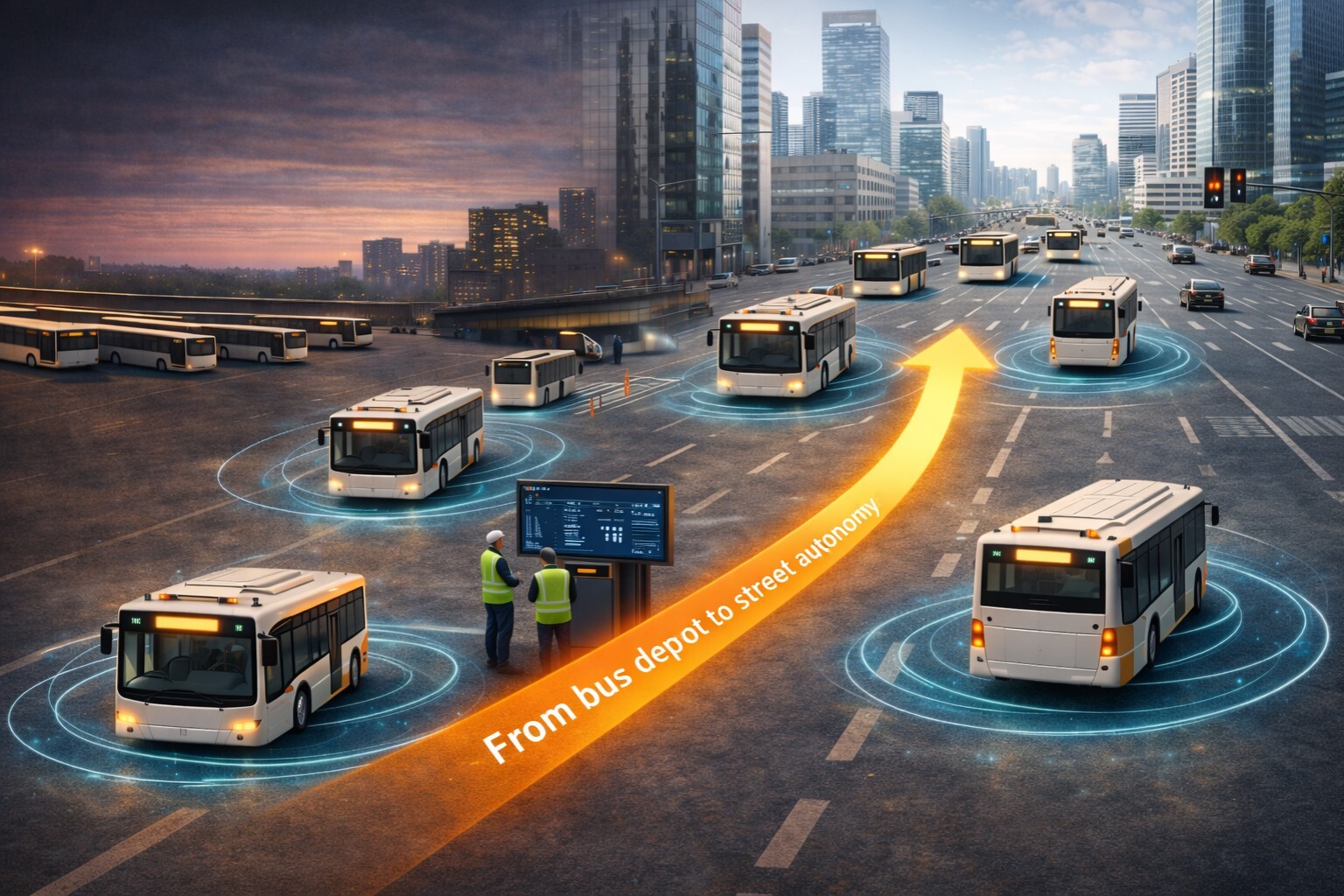
A smartbus is not a new vehicle—it's an ordinary bus transformed by a smart depot system. When a bus can park, charge, and move autonomously within the depot, it becomes operationally smarter, more efficient for operators, safer for drivers, and more reliable for passengers. This transformation happens without requiring wholesale fleet replacement or massive infrastructure investments, making it accessible to operators of all sizes.
The depot-first approach builds the technical and operational foundation necessary for road deployment. Autonomous systems gain real-world operational hours in a controlled environment, allowing continuous refinement and validation. Operators develop familiarity with autonomous technology, building confidence and competence that will be essential when expanding to public roads. And critically, the business case is proven through measurable ROI—recovered driver time, improved safety metrics, and enhanced operational efficiency—long before taking on the complexity and cost of road autonomy.
This isn't theoretical. Leading operators across Europe are already piloting smartbuses in their depots, preparing their organizations for the next phase of autonomous mobility. The bridge from depot to road exists—it's being built on proven technology, real operational results, and a clear value proposition that scales.
Why Starting Small Wins Big: The Business Case For Depot-First Autonomy
The business case for depot-first autonomy is straightforward: immediate value, manageable risk, and clear ROI. Unlike road pilots that consume millions with uncertain timelines and unclear paths to deployment, depot autonomy delivers measurable results from day one. Every minute recovered per vehicle compounds across the fleet, every collision avoided reduces insurance and repair costs, and every optimization in space utilization defers expensive depot expansion.
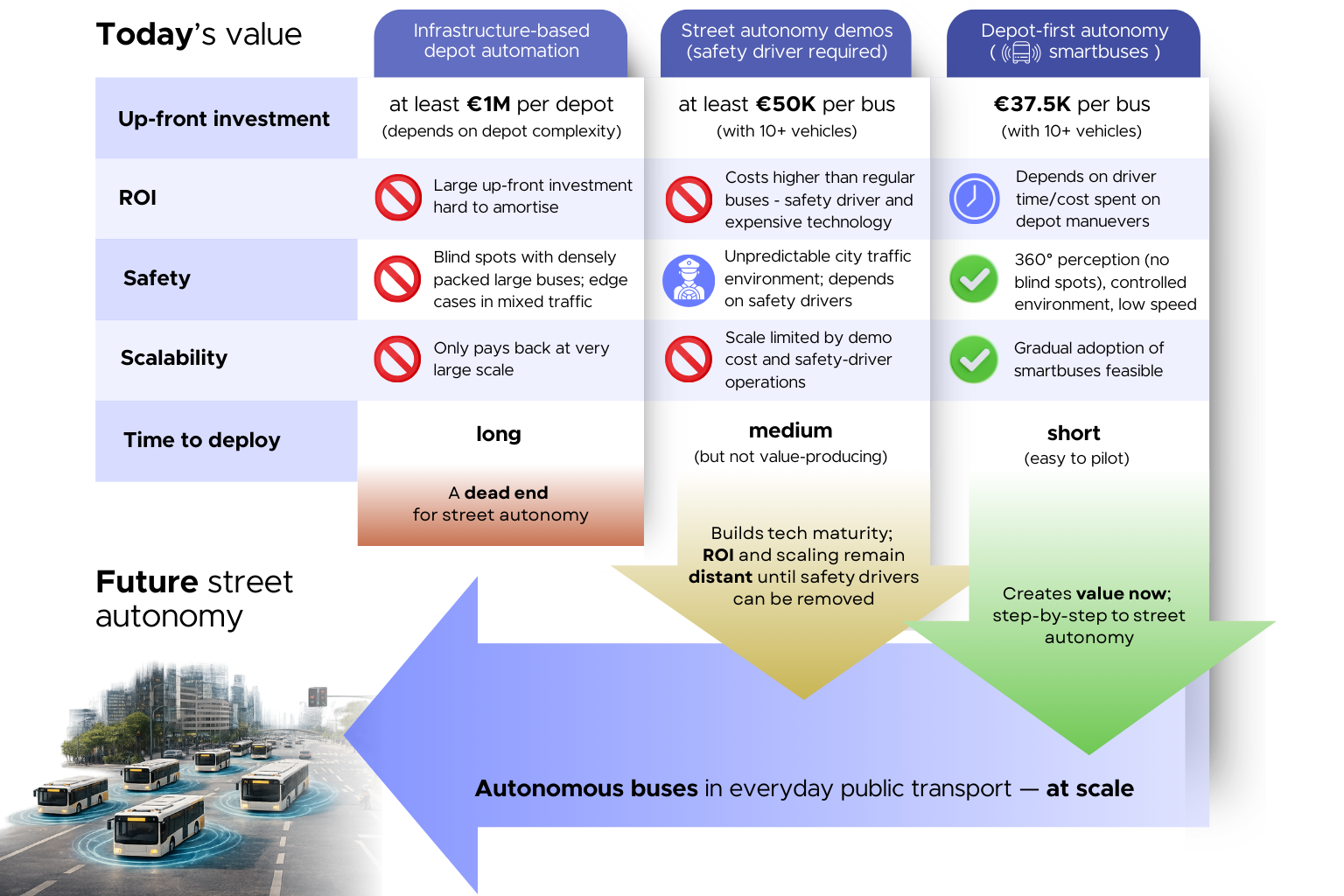
Consider the economics from an operator's perspective. Driver shortages aren't a future problem—they're an immediate constraint limiting service expansion and forcing difficult scheduling tradeoffs. SmartDEPOT™ recovers driver capacity without hiring, training, or competing in tight labor markets. The time saved on depot maneuvers translates directly into additional service hours or reduced overtime costs. For a mid-sized fleet, this can mean hundreds of recovered driver hours monthly—time that can be reinvested into passenger service or used to reduce operational strain.
Safety improvements deliver both direct and indirect value. Fewer depot collisions mean lower repair costs, reduced vehicle downtime, and decreased insurance premiums. But the benefits extend further: improved safety culture, reduced driver stress, and better asset utilization. When vehicles aren't sidelined for collision repairs, fleet availability improves, reducing the need for spare vehicles and enabling more efficient capital deployment.
Perhaps most importantly, depot-first autonomy is deployable now, with proven technology that works within existing regulatory frameworks. There's no need to wait for new legislation, no requirement for special permits or lengthy approval processes. Operators can begin realizing value immediately while building the operational foundation for future autonomous deployment. In an industry where margins are tight and resources are constrained, starting with solutions that deliver immediate ROI isn't just smart—it's essential.
The future of mobility doesn't begin with a driverless bus on a city street. It begins in the depot, where smartbuses are already transforming operations, recovering capacity, and proving that autonomous technology can deliver real value today. Cities and operators don't need more pilots—they need solutions that work at scale. Depot-first autonomy is that solution, turning the depot into a competitive advantage and building the credible path toward city-wide autonomous transport.