


Whenever I make the case for starting in the depot, someone asks whether it means giving up on the...
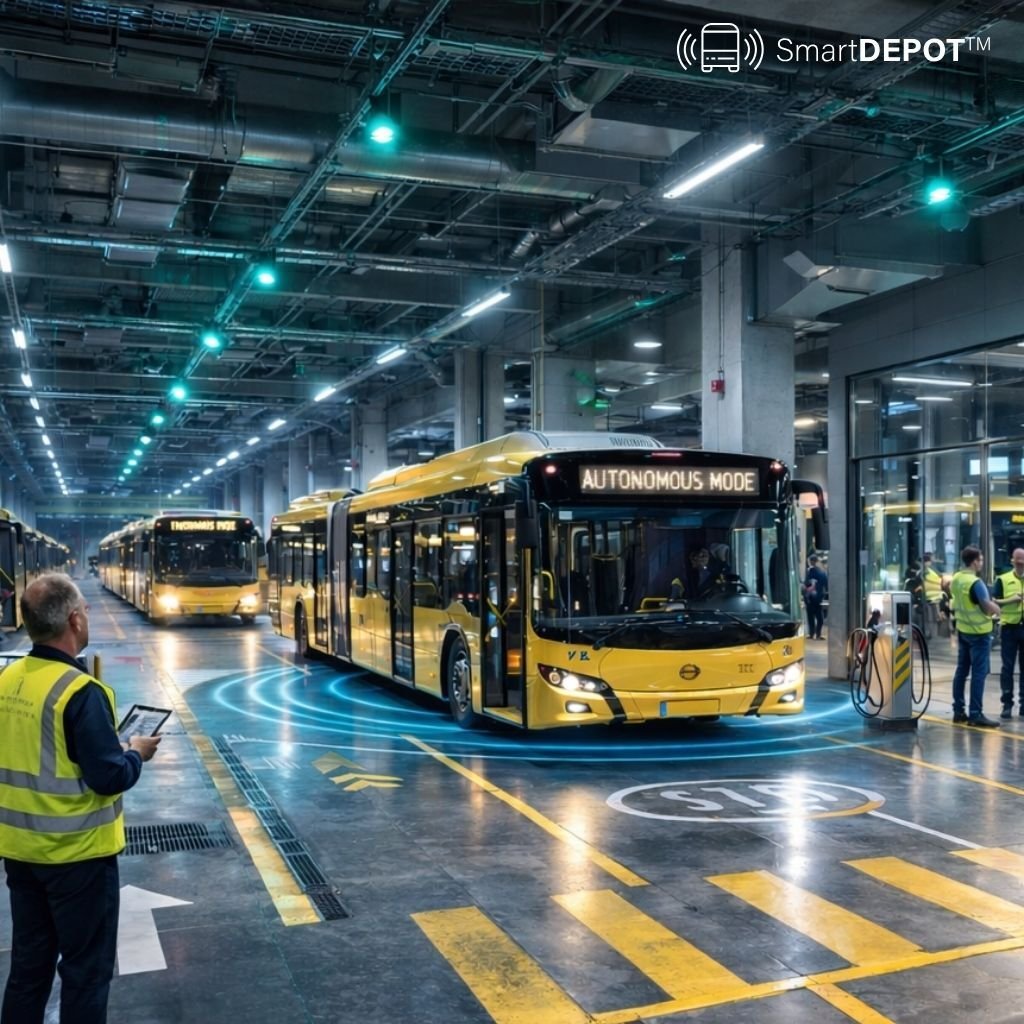
Much of the discussion around autonomous buses still focuses on when they will operate on public streets at scale, but for operators the more immediate question is where to start in a way that is operationally sensible, economically justified, and relevant to the longer-term path to autonomy. My view is that every journey to public-street autonomy needs a first stop, and for bus operators that first stop is the depot. That matters because the sector has already seen many pilots and demonstrations, while the practical entry point to adoption remains less clear - especially for operators trying to avoid very expensive retrofits. In practice, there are three obvious routes - retrofitting existing buses, infrastructure-based depot automation, and manufacturer-prepared depot-first autonomous vehicles - and while all three can be presented as something operators can do today, they differ significantly in cost, safety profile, and long-term value.
Retrofitting existing buses
Retrofitting is often presented as a fast route because it uses the existing fleet. In reality, it usually fails the operator’s reality test.
The cost is already substantial. Once the required engineering services, integration work, validation, and support are included, the total will rise above €100,000 per vehicle. Even where the technology works, the economics are difficult.
The timing is also awkward. Retrofit tends to become more feasible later in a vehicle’s life, often after warranty. But that leaves a shorter window to recover the investment. The point at which an operator is most able to modify the vehicle is often the point at which the return period is least attractive.
Then there is compliance. Safety, certification, maintainability, liability, and lifecycle support all matter. A retrofit approach carries those questions into a vehicle that was not originally prepared for them. That makes the whole proposition harder to industrialise, harder to certify cleanly, and harder to scale.
Infrastructure-based depot automation
Infrastructure-based depot automation does not create a meaningful migration path toward autonomous buses on public streets.
It also has high up-front infrastructure cost. Depending on depot complexity, the investment can easily reach €1 million or more per site.
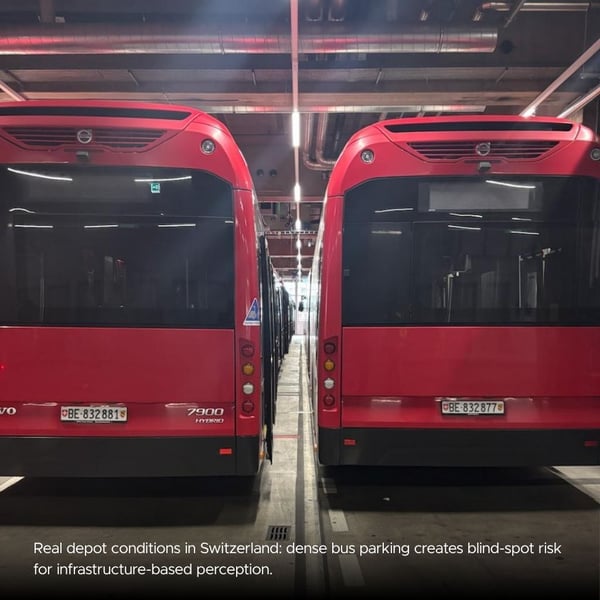
The key issue is safety. Depots are dense environments with large vehicles, tight spacing, occlusions, and people moving unpredictably. A person can step out between parked buses or appear in a gap that is partially hidden from fixed infrastructure sensors. In that situation, safety depends heavily on sensor placement, line of sight, and complete coverage of the environment.
This creates a basic problem: the larger and denser the depot operation, the more difficult it becomes to rely on infrastructure alone to see everything that matters at the moment it matters. Even with strong coverage, residual detection uncertainty remains. When human life or health is at stake, that is not a risk operators can treat lightly.
Depot-first vehicles
That leaves manufacturer-prepared depot-first vehicles.
Speeds are low. There are no passengers onboard during manoeuvring. The operating domain is narrower. Procedures can be defined more clearly. Validation is more realistic. Safety cases are easier to build around actual operations rather than idealised assumptions.
There is also a direct operational case. Depot manoeuvres are necessary work, but they are not high-value driving tasks. Parking, repositioning, dispatching, washing, charging movements, and maintenance flows all consume time and labour. If autonomy can take on some of that work safely and consistently, the result is an operational improvement now.
A vehicle-based approach also fits the practical realities of public transport better. If the vehicle is prepared by the manufacturer, the path on compliance, maintainability, support, and cost is generally more coherent than in a retrofit model. That does not remove all challenges, but it places them in a framework that operators and manufacturers already understand. Just as importantly, the capability sits on the vehicle itself, which makes it more relevant to the longer-term path toward broader autonomy.
More on ROI of depot-first autonomy here.
Why this matters now
Public-street autonomy remains the destination, but the starting point has to carry its own weight. It has to create value now, improve safety in a defined environment, fit procurement and compliance realities, and give operators a practical way to build experience before moving into more complex operating conditions.
That is why the depot matters. It is one of the few places where operators can begin with an application that delivers value today and remains relevant tomorrow.
For operators who want to explore that starting point in a practical way, find out more on Smartbus Onboard Program at pto.smartdepot.tech