
Most conversations about autonomy start with the technology. Let me start with a single number...
The shift to electric is the most visible success story in public transport. In 2025, zero-emission buses reached 60% of all new city-bus sales in Europe; registrations grew 48% year on year; there are now around 32,000 e-buses operating across the continent. The market has passed its tipping point.
Here's the part that gets less attention: electrification didn't simplify the depot. It made it considerably harder.
A diesel bus has a beautifully simple depot life. It arrives, it parks, it's ready again in the morning. Refuelling is fast and location-independent. The yard is essentially a car park.
An electric bus is a different animal. It has to park in a specific location, near the right charger. It has to connect in the right sequence so the depot doesn't hit an expensive grid peak. It has to be monitored through the night. And if its state of charge is lower than expected at 03:00, someone has to make a last-minute adjustment to be sure it's ready for the 05:20 departure.
Now add the most common real-world wrinkle: more buses than chargers. It happens whenever fleet expansion outpaces charging infrastructure — which is most of the time. The moment that's true, the evening stops being "park and plug in" and becomes a physical rotation: vehicles shuffled between charging bays, wash positions and parking slots through the night. Every one of those movements needs a driver or a shunter. And the coordination effort doesn't grow linearly with fleet size — it compounds.
This is the quiet truth behind the electrification numbers. Operators running larger, more complex electric fleets are discovering that their depot processes — designed, often decades ago, for diesel — were never built for this environment. Charging is no longer a task. It's choreography.
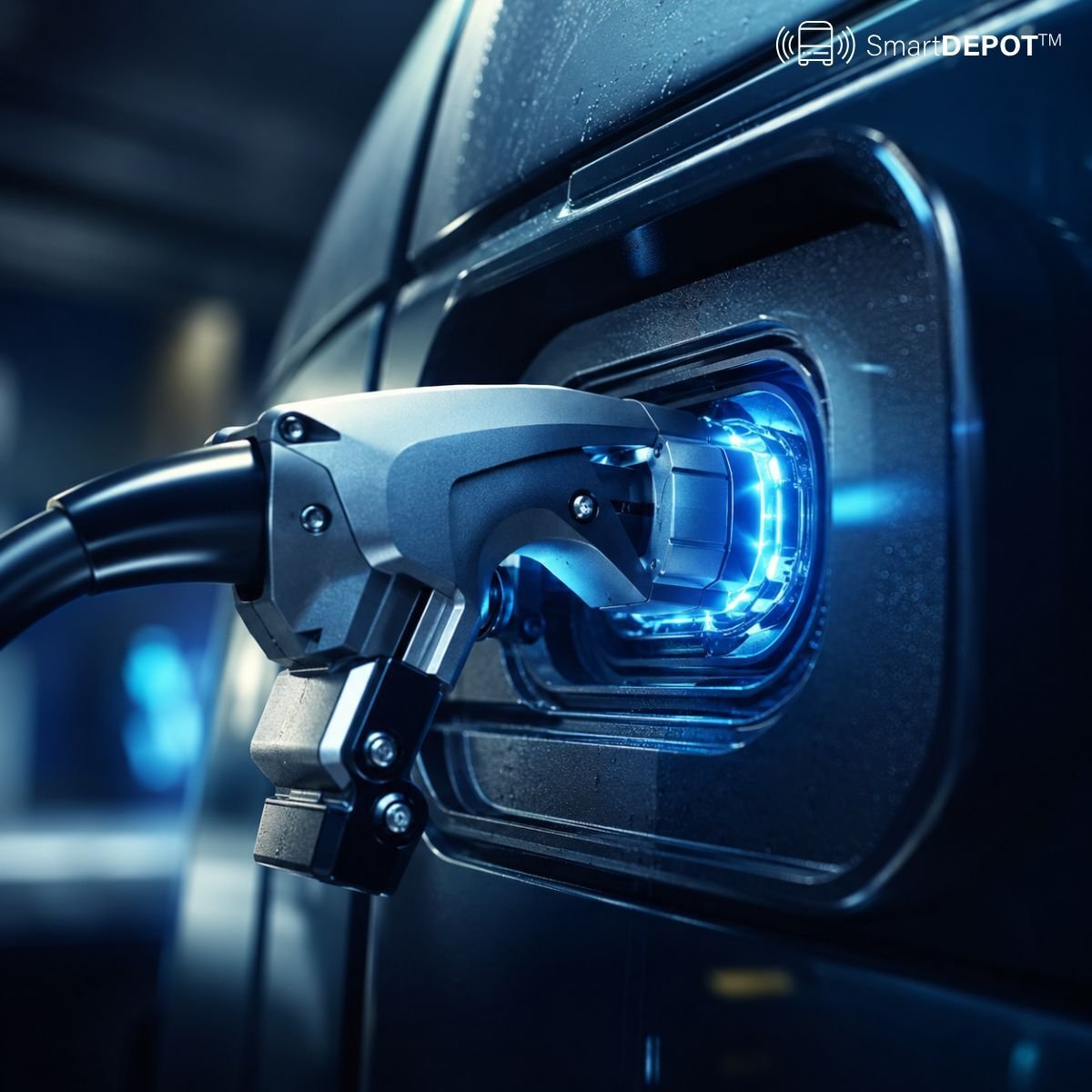
The good news: choreography is exactly the kind of problem software is good at. A smart charging system replaces arrival-time-and-intuition with algorithmic priority. It knows which bus leaves at 05:30 needing a full charge, which has a higher-priority morning route, and which can charge slowly overnight. It assigns each vehicle to the appropriate charger — high-power DC for the tight-schedule buses, lower-power AC for the ones with time — and re-plans dynamically as reality diverges from the plan.
The economics follow directly:
- Energy. Shifting charging into the cheapest windows (typically 01:00–04:00) cuts energy costs 9–15% depending on tariff. For a 100-bus fleet that's around €250,000 a year — over €2.5 million across a decade.
- Grid. Coordinated charging shaves the simultaneous peaks that trigger demand charges — and in grid-constrained depots, it can defer or eliminate a costly upgrade entirely.
- Hardware. Matching dwell time to charger power preserves your expensive fast chargers for the buses that actually need them, extending hardware life and improving ROI.
And there's a structural prize beyond cost. The same infrastructure layer that enables smart charging — real-time state-of-charge visibility, dynamic scheduling, the ability to interrupt and resume charging on demand — is exactly what Vehicle-to-Grid will require. Operators investing in smart charging today are quietly positioning themselves to sell energy back to the grid tomorrow.
One more thing worth saying to anyone designing or refurbishing a depot: charging and movement are not two separate problems. When every parking space is also a charging point, the system that decides where a bus parks is the same system that decides when and how fast it charges. You cannot optimise one without the other. They should be specified together — not bought as separate line items.
Electrification was the hard part you've already done. The depot is the part the electrification made harder. It's also the part with the clearest, fastest payback.
The full smart-charging economics — tariff modelling, grid impact, and how charging links to autonomous movement — are in The State of Smart Depots 2026.